Kaltra introduces new downward-spraying distribution technology to boost microchannel evaporator performance
In microchannel evaporators, overall thermal performance is strongly governed by the uniformity of refrigerant distribution among parallel microchannels.
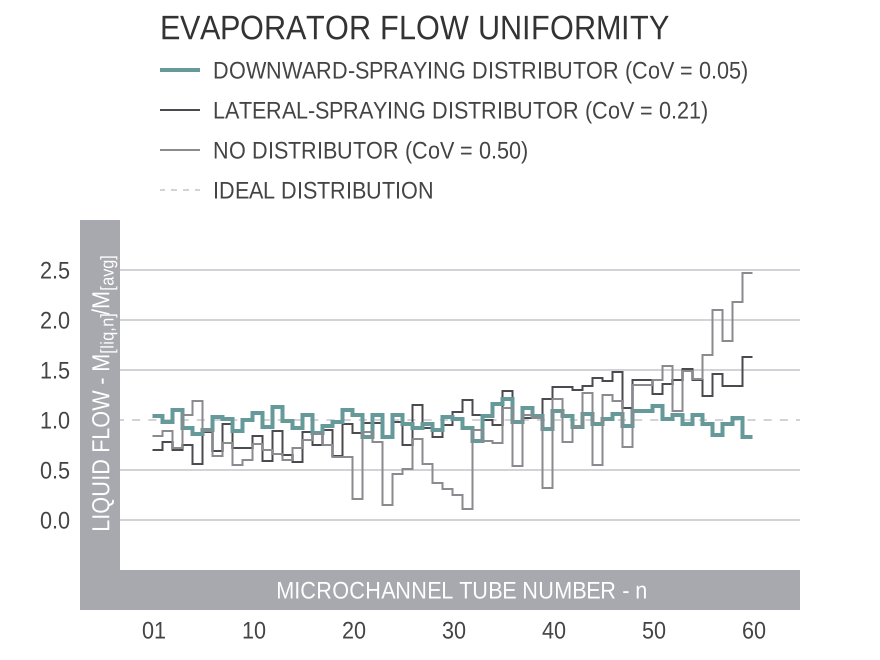
When a two-phase refrigerant mixture enters a horizontal inlet header, phase separation naturally occurs due to differences in density, momentum, and gravitational forces. The denser liquid phase, possessing higher inertia, tends to travel further along the header, while the lighter vapor phase preferentially occupies the upper region of the manifold. This stratification promotes uneven feeding of downstream microchannels: channels located near the inlet may receive predominantly vapor, whereas channels farther downstream may experience liquid-rich or intermittent slug flow conditions. The resulting vapor quality imbalance leads to suboptimal surface utilization and reduced evaporator effectiveness. To address this issue, Kaltra initially implemented an internal lateral-spraying distributor consisting of a perforated tube installed inside the inlet header. Orifices were arranged along its length on opposing sides, oriented at 90° relative to the microchannel tube inlets. This configuration improved refrigerant dispersion compared to an open-header design; however, because injection momentum remained primarily horizontal, gravity-driven stratification was only partially suppressed. Under such conditions, evaporators equipped with lateral-spraying distributors typically demonstrated performance losses of approximately 10–15% relative to near-ideal uniform distribution. Evaporators without any internal distributor exhibited substantially greater degradation. In these configurations, pronounced phase separation within the header resulted in performance losses of approximately 25–35%, primarily due to channel underfeeding, localized flooding, and incomplete heat transfer surface utilization. Figure 1: Evaporator surface superheat Figure 1 shows that inadequate liquid distribution causes dry-out in underfed microchannel tubes, creating superheated regions. Sensible heating of the vapor dominates, resulting in a surface temperature spike above saturation and a significant loss of heat transfer efficiency. As part of the present research program, Kaltra developed a novel Downward-Spraying Distributor (DSD) architecture. In this configuration, refrigerant is injected vertically downward into the header through calibrated orifices. Unlike conventional lateral injection, the DSD deliberately aligns jet momentum with gravitational forces. This approach provides several hydrodynamic advantages: By combining gravity-assisted liquid transport with controlled jet-induced turbulence, the DSD significantly increases mixing efficiency within the inlet manifold. The resulting two-phase flow exhibits markedly improved vapor quality uniformity across the full width of the evaporator core, leading to enhanced heat transfer effectiveness and more stable coil operation. Figure 2: Evaporator flow uniformity Experimental validation (Figure 2) demonstrated that evaporators equipped with the DSD architecture exhibit performance losses as low as approximately 1–3%, approaching ideal distribution conditions. In comparison, lateral-spraying distributor configurations show losses of 10–15%, while systems without any internal distributor experience degradation in the range of 25–35%. These results confirm that controlled downward injection is substantially more effective in mitigating phase separation than lateral or non-directed header configurations.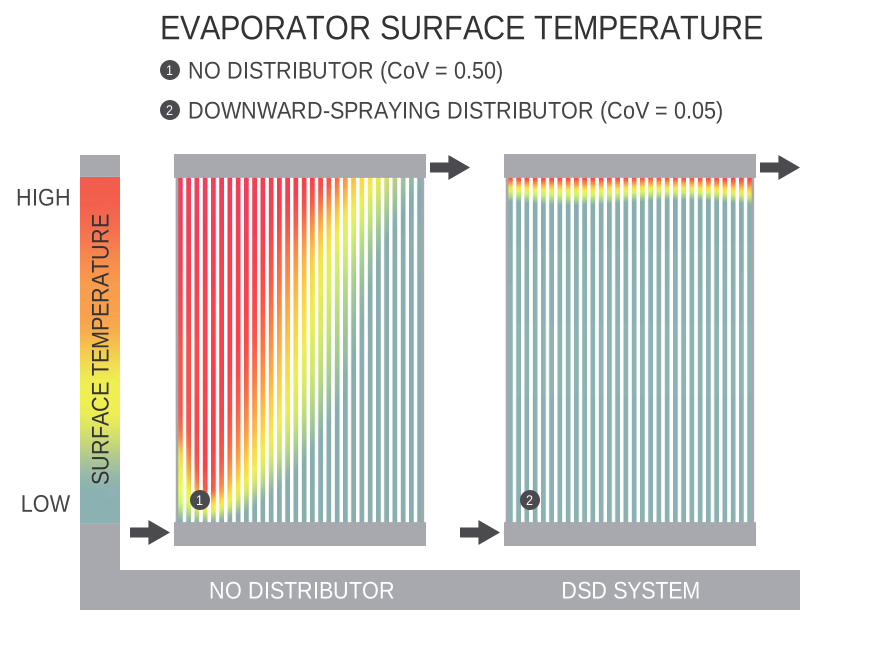
|
FEATURE |
DOWNWARD-SPRAYING DISTRIBUTOR |
HORIZONTALLY-SPRAYING DISTRIBUTOR |
|---|---|---|
|
Coefficient of variation |
~0.07 (Excellent) |
~0.21 (Intermediate) |
|
Liquid capture |
Direct |
Splash-off |
|
Vapor sensitivity |
Low |
High (droplets easily diverted) |
Table 1: Coefficient of variantion (refrigerant uniformity)
Testing further confirmed high refrigerant distribution uniformity for coil inclination angles up to 30° and for inlet vapor qualities below 0.4, indicating robust operational stability under realistic installation geometries and load conditions.